
1. Introduction
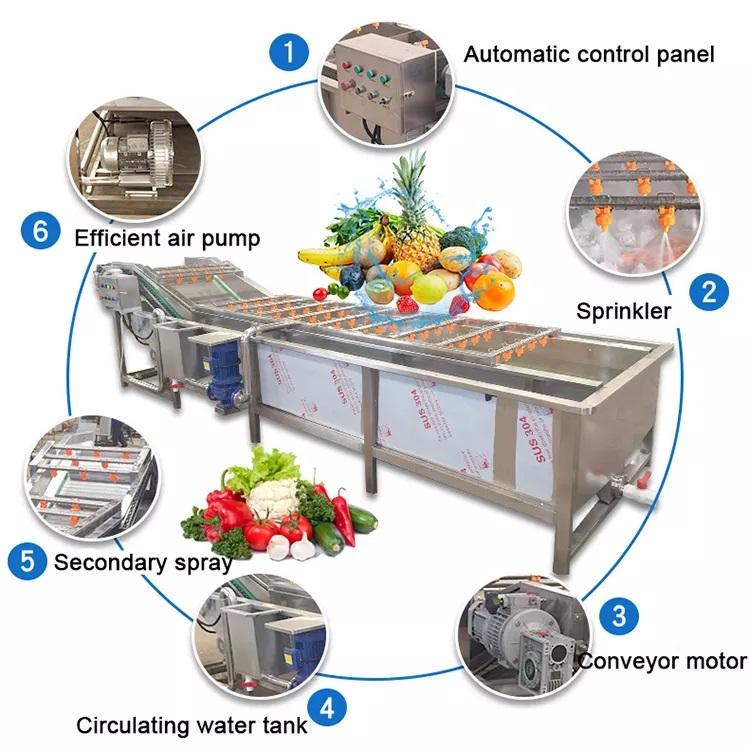
Le bubble washing machine vegetable and fruit is an advanced piece of equipment designed for cleaning fresh produce using a combination of water immersion et air bubble agitation. This cleaning method is doux, efficace, et respectueux de l'environnement, Le rendre adapté à des produits délicats et fermes.
As global consumers increasingly demand prêt-à-manger, pré-lavé, and organic-certified produce, processors are upgrading from traditional manual washing to fully automated bubble washing systems.
1.1 Why Bubble Washing Matters in Modern Food Processing
- Compliance en matière de sécurité alimentaire
Regulatory agencies such as the FDA, EU Commission, and CFIA require food producers to minimize microbial contamination, résidus de pesticides, and physical debris. - Product Quality Preservation
Bubble washing prevents bruising, discoloration, and nutrient loss, especially important for export markets. - Efficacité opérationnelle
Handles high volumes — from 500 kg/h for small plants à 10,000+ kg/h for large industrial facilities.
2. How a Bubble Washing Machine Works
UN bubble washing machine vegetable and fruit uses air bubbles generated by a blower to gently agitate produce in water, loosening dirt and contaminants.
2.1 The Process Flow
- Loading
Produce enters via a conveyor or manual hopper. - Water Tank Immersion
Fruits and vegetables are fully submerged. - Bubble Injection
Compressed air enters through perforated pipes, creating turbulence. - Dirt Separation
Heavy particles settle, light debris floats away. - Final Rinse
Clean water sprays remove any residual contaminants. - Décharge
A conveyor transfers produce to the next processing stage.
2.2 Key Science Behind Bubble Cleaning
- Hydrodynamic Effect: Bubbles create micro-currents that penetrate leaf folds.
- Surface Tension Reduction: Air bubbles reduce adhesion between dirt and produce skin.
- Oxygen Enrichment: Helps maintain freshness during cleaning.
3. Machine Design & Composants
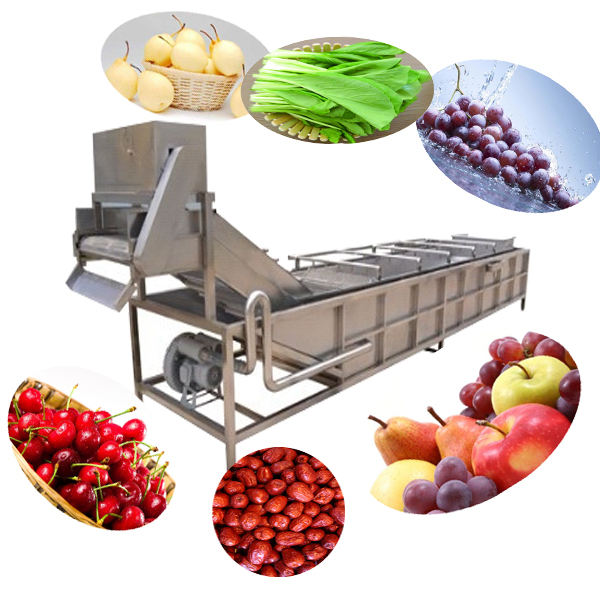
Le bubble washing machine vegetable and fruit is engineered for durabilité, hygiène, et nettoyage facile.
| Composant | Fonction |
|---|---|
| Water Tank | Holds the washing solution. |
| Souffleur d'air | Generates air for bubble production. |
| Mesh Conveyor | Moves produce through the cleaning zone. |
| Sediment Trap | Collects heavy debris. |
| Overflow Outlet | Removes floating impurities. |
| Rinse Section | Provides final clean water spray. |
| Panneau de contrôle | Manages speed, air flow, and water circulation. |
Matériel: SUS304 en acier inoxydable (standard), SUS316 for highly acidic produce.
4. Tableau des paramètres techniques
| Modèle | Capacité (kg/heure) | Pouvoir (kW) | Water Volume (L) | Dimensions (mm) | Poids (kilos) | Matériel |
|---|---|---|---|---|---|---|
| DT-500 | 500 | 2.2 | 400 | 3000× 1000 × 1300 | 280 | Sus304 |
| DT-1000 | 1000 | 3.7 | 600 | 4000×1200×1300 | 380 | Sus304 |
| DT-2000 | 2000 | 5.5 | 900 | 5000×1400×1350 | 520 | Sus304 |
| DT-3000 | 3000 | 7.5 | 1200 | 6000×1500×1400 | 650 | Sus304 |
| DT-5000 | 5000 | 11 | 1500 | 8000×1600×1450 | 950 | Sus304 |
5. Product Applications
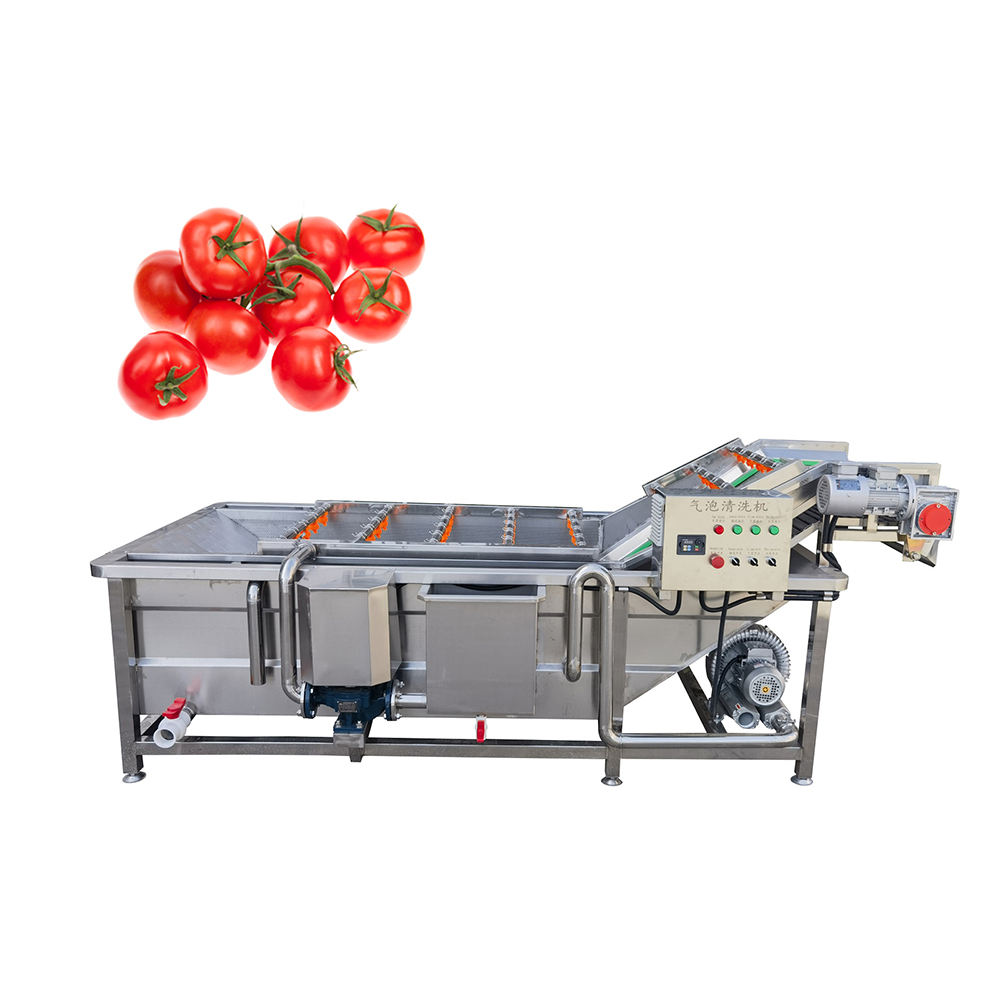
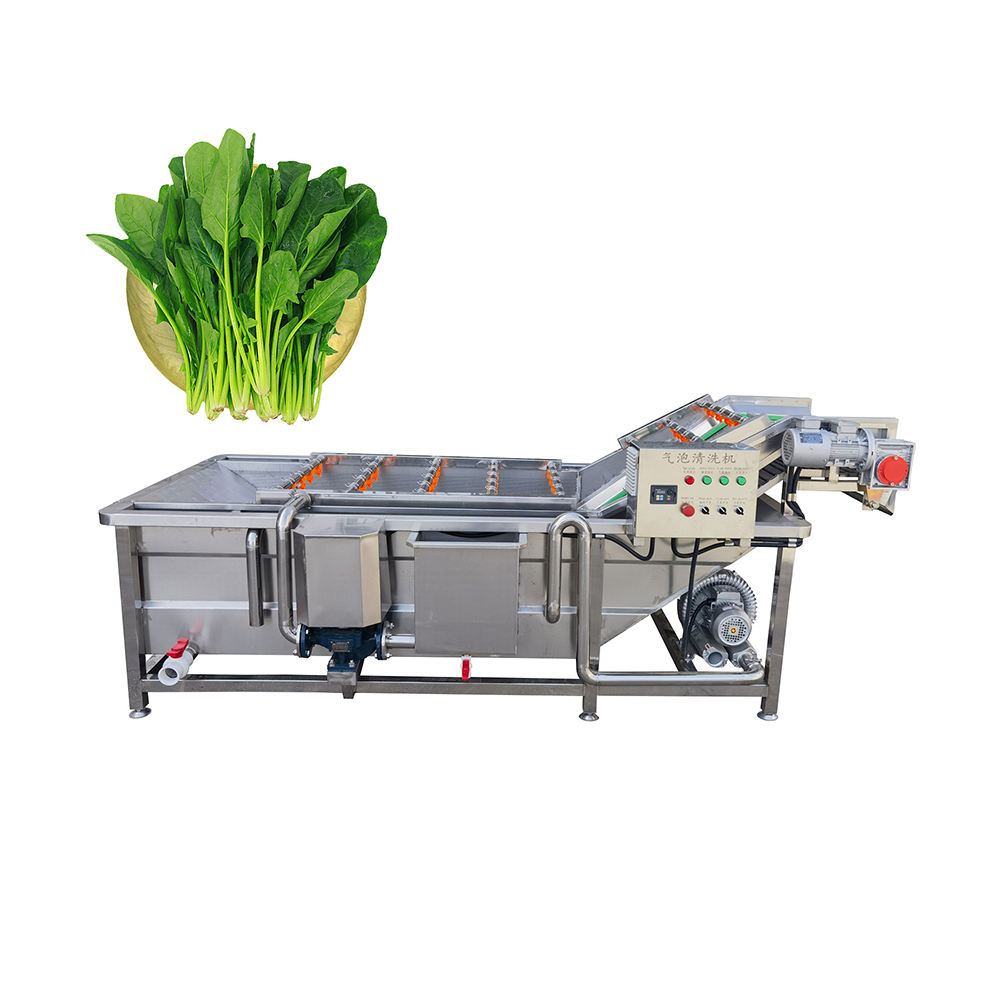
- Leafy Greens: Laitue, épinard, kale, chou.
- Root Vegetables: Carottes, pommes de terre, radishes, beets.
- Fruits: Fraises, grapes, pommes, citrus.
- Herbes: Mint, basilic, coriander.
- Medicinal Plants: Ginseng, chrysanthemum.
6. Benefits Over Other Washing Methods
| Fonctionnalité | Machine à laver à bulles | Spray Washing | Lavage manuel |
|---|---|---|---|
| Damage to Produce | Très faible | Moyen | Variable |
| Cleaning Thoroughness | Haut | Moyen | Faible |
| Exigence de main-d'œuvre | Faible | Moyen | Haut |
| Water Use Efficiency | Haut | Moyen | Faible |
7. Guide d'installation
- Select Location – Level floor, near water & drainage.
- Install Utilities – Connect 3-phase power, water inlets, and drainage.
- Assemblée – Attach blower, convoyeur, and rinse sections.
- Essai – Run with water only to check for leaks.
8. Operation Tips
- Pre-rinse heavily soiled produce before loading.
- Adjust bubble intensity for delicate items.
- Keep water temperature low to maintain freshness.
9. Maintenance Schedule
| Fréquence | Action |
|---|---|
| Tous les jours | Drain & clean tank, rinse filters. |
| Hebdomadaire | Inspect blower and pump. |
| Mensuel | Remove scaling, sanitize tank. |
| Annuel | Remplacer les joints, roulements. |
10. Eau & Energy Saving Features
- Recirculation system reuses up to 80% of water.
- Automatic debris removal extends water life.
- Variable blower speed reduces power use.
11. Études de cas
Cas 1 – Leafy Green Processor in California
- Capacité: 3000 kg/heure
- Résultat: Reduced labor by 70%, water use by 40%.
- Retour de retour: Achieved in 14 mois.
Cas 2 – Berry Exporter in Chile
- Capacité: 2000 kg/heure
- Résultat: Reduced bruising damage from 6% to under 1%.
12. Tendances du marché
- Demande croissante de organic-certified washed produce.
- Increasing adoption in Asie-Pacifique due to export markets.
- Intégration avec optical sorting machines.
13. Comment choisir la bonne machine
- Capacity Requirements
- Type de produit
- Disponibilité de l'espace
- Budget and ROI Goals
- Support après-vente
14. Price Ranges
- Petit (500–1000 kg / h): $2,500–5 000$
- Moyen (2000–3000 kg / h): $6,000- 10 000 $
- Grand (5000+ kg/heure): $12,000–20 000$+
15. Extended FAQs
Q: Can it be used for seafood?
UN: Oui, with proper corrosion protection.
Q: Can it connect to peeling machines?
UN: Oui, commonly integrated in full processing lines.
Q: Is ozone disinfection available?
UN: Oui, as an optional add-on.
16. Troubleshooting Guide
| Problème | Cause possible | Solution |
|---|---|---|
| Weak bubbles | Low blower pressure | Check blower filter |
| Poor cleaning | Overloaded tank | Reduce feed rate |
| Water overflow | Blocked drain | Clean outlet |
17. Conclusion
UN bubble washing machine vegetable and fruit is not just a cleaning device — it’s a productivité, qualité, and safety investment. With the right model, you can increase throughput, améliorer l'hygiène, and reduce operational costs.